Setting up a "Custom Conversation"
Last updated: April 22, 2026
Custom Conversation Overview
Unlike other simulation types, Custom Conversation begins without any predefined context. This simulation type acts like a blank slate, ensuring that course creators can tailor simulations to meet specific training needs.
NOTE:
This article only discusses the unique aspects of the Custom Conversation simulation. Please see “Customizing Simulation Tasks” for additional information on how to customize simulations.
Personalize Your Simulation
The Personalize Your Simulation section is where the creator can tailor a simulation to their specific needs. Within this section, press Edit to customize conversation parameters for your simulation. This will launch a Personalize Your Simulation page. When you are finished adding details to this page, press the Save button at the bottom.
TIP:
The more information you enter, the more accurate and consistent the AI Persona will be with its responses.
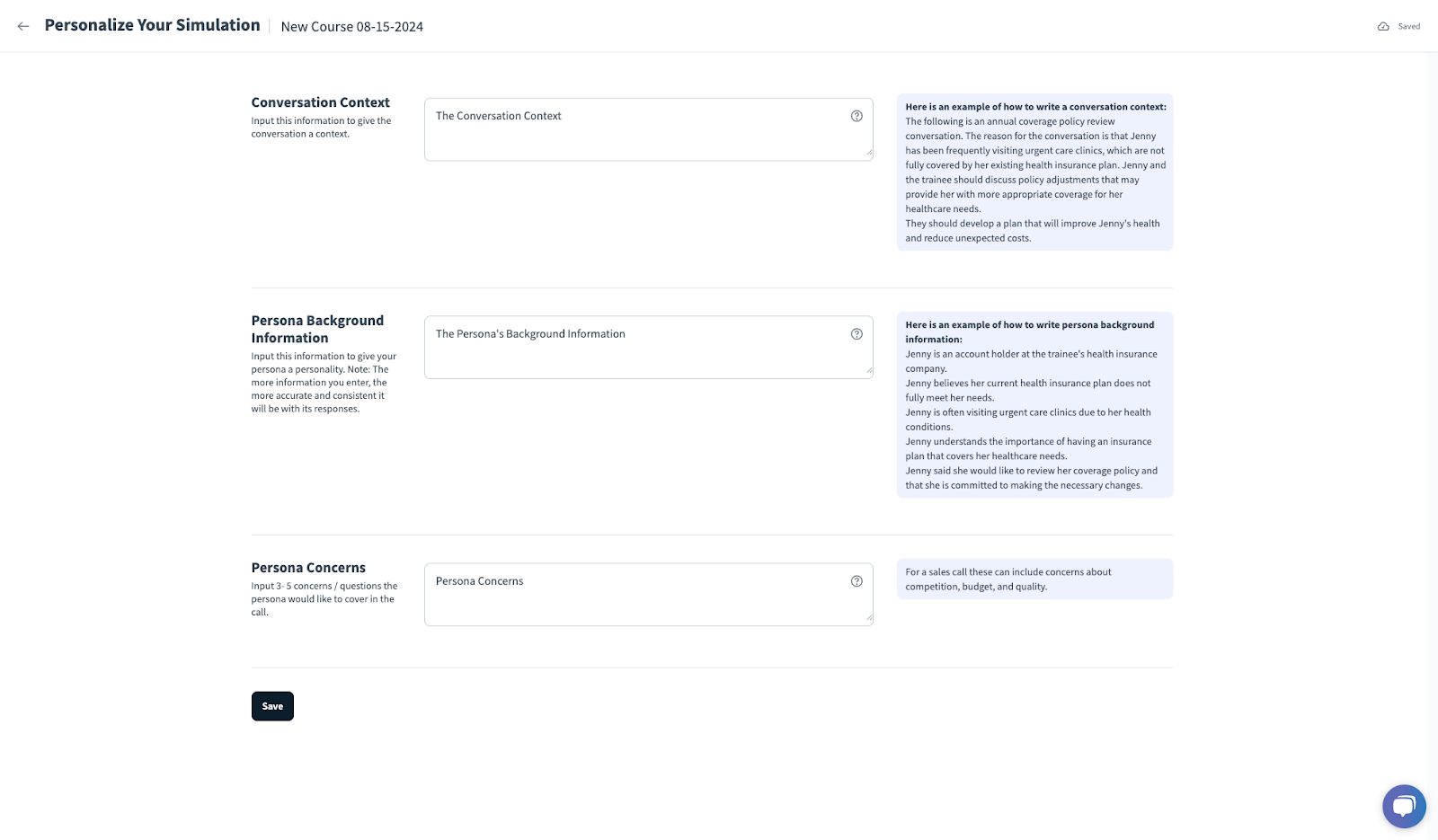
There are typically three prompts for personalizing your simulation:
1. Conversation Context: This prompt provides background information to the trainee on where the simulation takes place, such as the location, stage of the deal process, the objective of the call, and anything else that will help set the stage.
2. Persona Background Information: This prompt provides information for the AI persona to develop its personality further. Users may include details on what the persona of a real prospect or client is like, so that the AI Persona can mirror it.
3a. Persona Concerns: This prompt allows for 3-5 concerns or questions that the persona would like to cover in the call. This gives the conversation a framework and ensures the trainee can address key points effectively. A persona concern could be a product’s scalability, security risks, ROI, contract terms or any other details that is anticipated to be asked by a real prospect or client.
3b. Conversation Structure: This prompt is used to provide information on the outline of a conversation, such as formal introductions, motivation for sale, customer’s current plan, alternatives, purchase options, implementation guidelines, followup steps, and/or close. This section may mirror your topics list.
NOTE:
Personalize Your Simulation will differ between simulation types. While the "Custom Conversation" uses the Conversation Structure prompt (3b above), "Custom Conversation 2.0" has the Persona Concerns prompt (3a above).
Conversation 2.0 "Personalize Your Simulation" Examples
Three examples for the "Personalize Your Simulation" section for Conversation 2.0 are provided below to provide more clarity.
Example 1: Healthcare Scenario
Context: The trainee is on an annual coverage policy review conversation. Jenny has been frequently visiting urgent care clinics, which are not fully covered by her existing health insurance plan. The trainee and Jenny should discuss policy adjustments that may provide her with more appropriate coverage for her healthcare needs, aiming to improve her health and reduce unexpected costs.
Background: Jenny is an account holder at the trainee's health insurance company. She believes her current health insurance plan does not fully meet her needs. Jenny is often visiting urgent care clinics due to her health conditions. She understands the importance of having an insurance plan that covers her healthcare needs and is committed to making the necessary changes.
Concerns:
1. Competition: What are the coverage options for urgent care visits?
2. Budget: How will the new plan affect my premiums?
3. Quality: Are there any additional benefits with the new plan?
Example 2: Customer Service Scenario
Context: Jenny has been a loyal customer of our CRM for five years. Recently, our software had a bug that caused private emails to be sent to her contacts. Jenny is furious. The trainee needs to figure out how to resolve the situation so Jenny does not churn as a customer.
Background: Jenny is a small business owner who relies heavily on CRM software for her customer communications. She has been using the company's CRM for five years without issues until the recent bug. Jenny values reliability and trust, which have been compromised by this incident.
Concerns:
1. Reassure Safety: How can you guarantee this won't happen again?
2. Compensation: What compensation can I expect for the breach of privacy?
3. Restore trust: How will you restore my trust in your service?
Example 3: Cold Calling Scenario
Context: The trainee is making a first call to a potential client, a company that does not use energy-efficient lightbulbs. The goal is to convince the client to switch to the trainee's energy-efficient lightbulbs, highlighting benefits such as cost savings and environmental impact.
Background: Jenny is the procurement manager at a mid-sized company. She is responsible for purchasing office supplies and is keen on sustainability but is also very budget-conscious. Jenny's company currently uses traditional lightbulbs and has not yet explored energy-efficient options.
Concerns:
1. Cost savings: What are the cost savings of switching to energy-efficient lightbulbs?
2. Technical details: How difficult is the installation process?
3. Quality testing: What is the expected lifespan of your energy-efficient lightbulbs?
NOTE:
Please see “Customizing Simulation Tasks” for additional information on how to customize your simulations.